
The commercial real estate industry is shifting from “smart buildings” (data collection for human review) to “autonomous buildings” (AI-driven systems that analyze and adjust operations in real time). Key economic drivers include up to 40% energy savings via Siemens Comfort AI, up to 26% workforce productivity gains, and 4.4–7.7% rental premiums for certified healthy buildings. A phased adoption approach—starting with high-impact HVAC and parking systems, then scaling portfolio-wide—is recommended.
1. The End of the “Static Building” Era
Commercial real estate is entering a major turning point. For decades, buildings were often treated as fixed assets. Their value came mainly from location, size, tenants, and lease income. If a property was in the right market and had enough square footage, that was often enough.
That model is changing. Today, owners are dealing with volatile energy costs, labor shortages, stricter sustainability expectations, and rising tenant demands. In that environment, an inefficient building is no longer just inconvenient to operate. It can become a financial liability.
The old “dumb building” model is giving way to a new standard: buildings that can monitor conditions, adjust operations, reduce waste, improve comfort, and support better decision-making. Industry leaders, including Siemens, describe this as a convergence of several pressures at once. The built environment accounts for nearly 40% of global energy consumption, while people spend roughly 90% of their lives indoors. That means buildings now sit at the center of several major issues: energy use, occupant wellness, environmental impact, operating costs, and tenant experience.
Owners can no longer simply provide “space.” Increasingly, they need to provide an experience. That is where the idea of Experience as a Service becomes important. Tenants, employees, and investors are looking for buildings that are efficient, responsive, comfortable, and aligned with modern ESG expectations.
Buildings that fail to adapt risk becoming stranded assets. In real estate terms, that means properties that lose value because they are too inefficient, too expensive to operate, or unable to meet modern tenant and regulatory demands. The central shift is this: CRE must move beyond the basic idea of “smart buildings” and toward truly autonomous buildings.
Figure 1 — From Static Assets to Self-Aware Environments
2. Smart Buildings vs. Autonomous Buildings
The difference between a smart building and an autonomous building is important. A smart building collects data. It may have sensors, dashboards, alerts, and connected systems. But in many cases, a human still has to review the data and decide what to do.
That creates a problem: data overload. A building can generate thousands of alerts, but if every decision still depends on a facility manager checking a dashboard, the building is not truly self-optimizing. It is still human-dependent.
An autonomous building goes further. It does not just collect information. It can analyze conditions and make routine adjustments automatically within defined limits. For example, an autonomous system can adjust HVAC, lighting, ventilation, and energy use in real time based on occupancy, weather, indoor air quality, and demand patterns.
This shift is made possible by technologies such as Digital Twin 2.0, AI-driven analytics, and IoT sensors. Older digital twins often worked like static 3D models. Newer digital twins function more like live operating systems for buildings. They help owners understand what is happening in the building now, predict what may happen next, and optimize performance over time.
The practical result is a different role for facility teams. Instead of spending most of their time reacting to problems, facility professionals can become strategic operators. The AI handles thousands of small adjustments, while humans focus on higher-value decisions. This is the human-in-the-loop model. The building becomes more automated, but people still oversee the system, set the strategy, and intervene when judgment is required.
Smart vs. Autonomous Buildings
Operating Comparison| Category | Smart Buildings | Autonomous Buildings |
|---|---|---|
| Operating Model | Human-dependent insights and centralized control | AI-driven action and self-management |
| Human Role | Decisions often depend on human review | Humans remain involved, but routine decisions are handled by AI |
| System Interaction | Efficiency gains often happen in separate silos | IoT, cloud, AI, and building systems are orchestrated together |
| Decision Speed | Periodic decisions based on human review | Continuous, real-time, edge-optimized decisions |
Figure 2 — Comparative Analysis: Smart vs. Autonomous Buildings
3. The Economic Case for Autonomous Buildings
For institutional investors, the argument for autonomous buildings is not only technological. It is financial. Autonomous systems can improve performance in several key areas: labor efficiency, energy use, capital planning, and revenue generation.
Labor Efficiency
- Automation reduces manual work required to operate a building.
- System handles recurring decisions, freeing maintenance teams from routine ticket-chasing.
- Cisco's Penn 1 case study demonstrates a 26% improvement in staff efficiency.
Energy Savings
- Smart automation reduces energy consumption by 20% to 30%.
- Siemens Comfort AI overlays add an additional 6.5% to 40% in savings.
- AI reduces waste in unoccupied spaces and responds instantly to conditions.
CapEx Optimization
- Predictive maintenance detects early signs of system degradation.
- Addresses problems before they become expensive emergency shutdowns.
- Extends mechanical system lifecycle and reduces sudden capital calls.
Parking Monetization
- ParkAssist sensors make real-time garage availability fully visible.
- Integrates with Google & Apple Maps to direct demand directly to the asset.
- Enables dynamic pricing models based on occupancy and traffic patterns.
4. Comfort as a Marketable Asset
Autonomous buildings are not only about cutting costs. They can also help increase revenue. The original article cites MIT research indicating that “healthy” buildings in the U.S. attract rent premiums of 4.4% to 7.7% compared with uncertified peers. It also states that certified sustainable buildings earn a 6% rental premium.
The larger point is that comfort, health, and sustainability can become marketable features. A building that performs better may attract stronger tenants, support higher rents, improve liquidity, and potentially contribute to cap rate compression. In a competitive leasing environment, operational quality becomes part of the value proposition.
5. Compliance, Sustainability, and Cybersecurity
Autonomous buildings also help address regulatory and reporting pressure. As sustainability disclosure requirements grow — including frameworks such as SECR, CSRD, and local New York mandates — owners need reliable building data. Manual reporting can require hundreds of hours. Autonomous systems can help by capturing energy, occupancy, performance, and environmental data directly from building operations. That makes the building function like a compliance fortress: a property with built-in systems for measuring, documenting, and reporting performance.
But there is another side to this. A connected building is also a potential cybersecurity target. If HVAC, access control, lighting, elevators, and other systems are connected, they must be protected. Owners need to balance open, interoperable platforms with strong cyber defenses.
The original article emphasizes the importance of the ISA/IEC-62443 standard, especially two areas: Identification and Access Control, and System Integrity.
Cybersecurity Directive: ISA/IEC-62443 Compliance
Identification and Access Control
Authenticating every human user and every device that connects to the building network (e.g., via Cisco ISE).
System Integrity
Protecting building systems from unauthorized changes or manipulation, preventing attackers from interfering with HVAC command parameters.
6. Global Examples of Autonomous Buildings
Several global projects show what this future can look like when buildings are treated as digital products, not just physical structures.
The Edge, Amsterdam
- Described as a 'computer with a roof' using IoT as its core operating model.
- Occupancy optimization via Mapiq app fits 2,850 employees onto 1,080 desks.
- Aquifer 130m below ground saves 42M kg of CO₂ over a decade by thermal storage.
BEEAH HQ, Sharjah
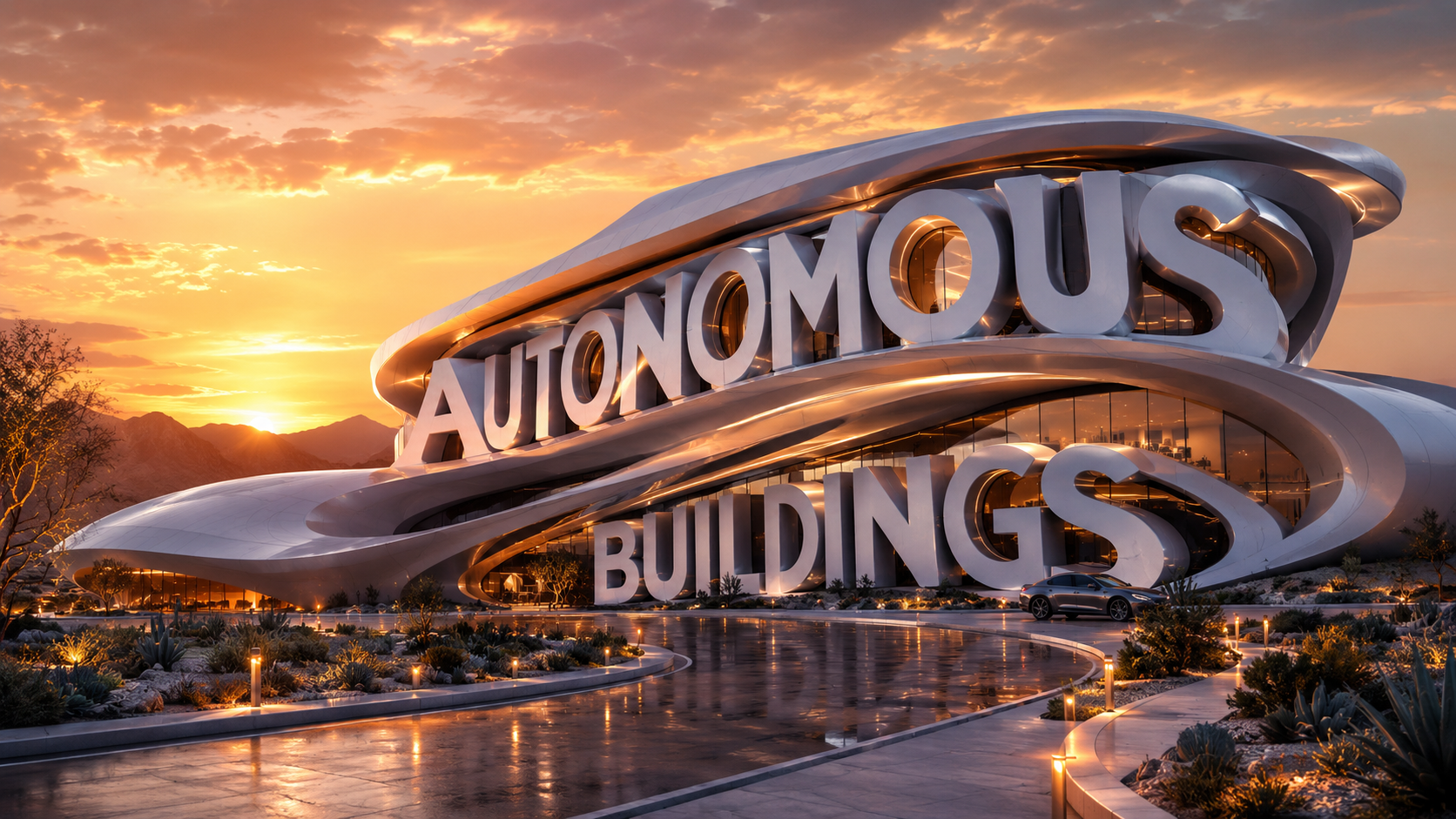
- Designed by Zaha Hadid Architects, powered entirely by renewable energy.
- Facial recognition & natural language AI improves employee comfort by 20%.
- Uses OpenBlue Digital Twin 2.0 for live data analysis and continuous self-optimization.
The lesson from both projects is that digital twins connect physical space with operational intelligence. They allow owners to understand how buildings are actually used and improve performance across the full asset lifecycle.
Figure 3 — The BEEAH Headquarters: A blueprint for the autonomous future.
7. The Barriers: Data Silos and Human Resistance
The move toward autonomy is not only a technical challenge. It is also an organizational one. The original article states that 75% of commercial buildings remain inefficient because of data silos. That means important information is trapped in disconnected legacy systems that do not communicate well with each other. This makes it difficult to optimize the building as a whole.
There is also a workforce concern. Some facility professionals may worry that automation will replace them. The article’s conclusion is different: autonomy should be seen as workforce transformation, not workforce elimination.
Autonomy represents a workforce transformation, not elimination. Operators evolve from chasing manual tickets to strategic system management, guiding AI co-pilots.
Workforce Co-Pilots
Autonomy represents a workforce transformation, not elimination. Operators evolve from chasing manual tickets to strategic system management, guiding AI co-pilots.
8. A Practical Roadmap for Owners
Owners do not need to make the full leap to autonomy all at once. A phased approach is more realistic and more likely to build trust.
Begin with clear, high-ROI areas like HVAC optimization or parking visibility. These produce immediate quick wins to validate the financial case.
Move toward open, standards-based platforms. Break down data silos and allow building systems to communicate dynamically with each other.
Expand the proven asset-level model across multiple buildings, transforming autonomy into a robust portfolio-wide strategy.
9. Conclusion: Autonomy Is a Resilience Strategy
Autonomy in CRE is not just a technology trend. It is a response to market pressure. Energy volatility, labor shortages, ESG expectations, tenant experience demands, and capital market discipline are all pushing buildings to become more efficient and more intelligent.
The next generation of valuable CRE assets will not simply be well-located. They will be connected, data-integrated, secure, efficient, and capable of adapting in real time. Buildings that are “born connected” will be better positioned to attract tenants, protect NOI, meet compliance demands, and draw institutional interest.
The final takeaway is simple: Resilience is no longer just about surviving change. It is about owning buildings that can anticipate change. Every square foot now has to justify its footprint.
Want to discuss this further?
The market moves fast, but you don't have to navigate it alone. Connect with our advisory team to explore how these insights impact your specific real estate strategy.
Contact Our AgentsFrequently Asked Questions
What is an autonomous building?
An autonomous building uses AI and real-time sensor data to dynamically analyze conditions and make routine operational adjustments—such as HVAC, lighting, ventilation, and energy use—automatically, without requiring human intervention for each decision.
How does an autonomous building differ from a smart building?
A smart building collects data via sensors, dashboards, and alerts, but a human still reviews the data and decides what to do. An autonomous building goes further: it can analyze conditions and execute adjustments in real time within defined parameters.
What are the economic benefits of autonomous buildings?
Autonomous systems can reduce energy consumption by up to 40% (Siemens Comfort AI), boost workforce productivity by up to 26%, extend equipment life through predictive maintenance, and transform parking into dynamic revenue streams.
What rental premiums do healthy and sustainable buildings command?
MIT research shows certified healthy buildings attract 4.4% to 7.7% rental premiums, while sustainable certifications add approximately 6.0%. These premiums help protect assets from becoming stranded.
What is a practical roadmap for adopting autonomous building technology?
Owners can take a phased approach: start with high-impact use cases like HVAC optimization and parking automation, move to integrated open standards (e.g., BACnet, Project Haystack), and then scale portfolio-wide. Full overnight conversion is not required.