The End of the Office Cubicle: 5 Lessons from New York’s $787 Million Move to Build More Homes

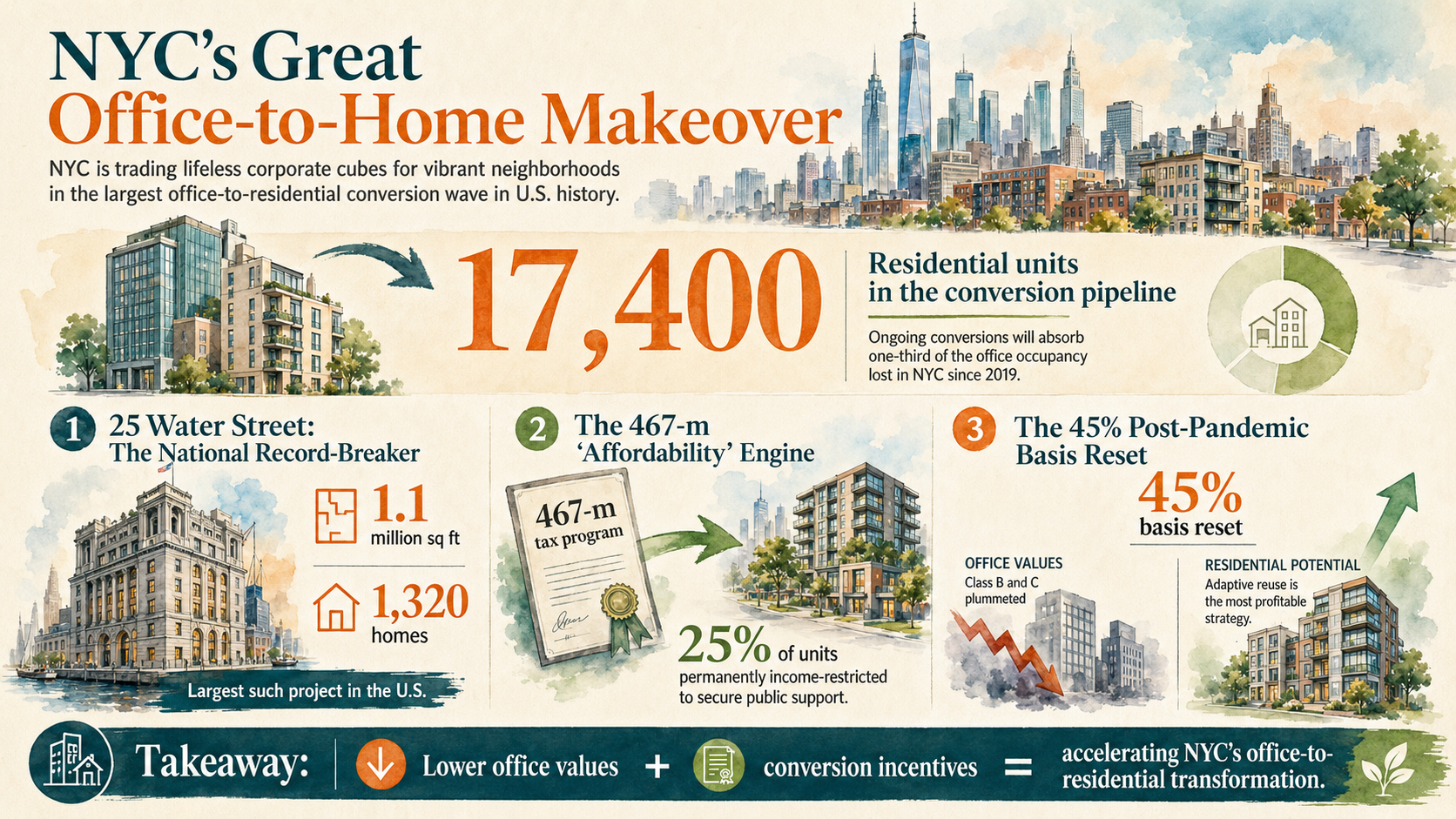
In the quiet streets of New York’s Financial District, people once worried the area would become a ghost town. After the pandemic, traditional office buildings—filled with rows of cubicles built for 9-to-5 work—seemed like they wouldn’t be needed anymore. However, at the corner of 25 Water Street, there is a new solution. A massive, empty office building is being turned into a huge apartment complex called “SoMA.” This is the biggest project of its kind in U.S. history.
This isn’t just one renovation; it’s a plan for the future of cities. By looking at the money and the new rules behind this $787 million change, we can see how New York is turning empty office space into lively neighborhoods for people to live in.
1. The Financial Help That Makes It Work
A tax break program called 467-m is what really makes these projects possible. Even though people need more housing, turning an old office into apartments is very expensive and often doesn’t make financial sense for developers without help. This program changes the math, making it profitable to convert these buildings.
According to city officials, this incentive is essential. It nearly doubles the value of the project for developers, moving it from a losing investment to a successful one.
"Most of the money the city “loses” from this tax break actually goes toward making some of the apartments cheaper for people with lower incomes."
2. A Massive Project at 25 Water Street
The work at 25 Water Street proves that you can turn big offices into homes on a huge scale. This project is creating 1,320 new apartments. It was a major construction challenge; the teams didn’t just fix the inside—they actually added ten new floors to the top of the building.
Because of new, flexible city rules and the $787 million investment, they are finishing the work very quickly. This shows that fixing up old buildings can be just as fast as building brand-new ones.
SoMA by the Numbers
1.1M
Total Area
1,320
Delivered
$787M
Total Cost
10
Added
3. The Gap Between Fancy and Old Offices
To understand why so many apartments are being built, you have to see that not all office buildings are the same. The market has split in two: high-end, “five-star” offices that are still popular, and older, less desirable buildings that are sitting empty.
While the fancy offices are still full, the older ones have lost a massive amount of tenants. These older buildings are perfect for turning into homes because they usually have better layouts for windows and natural light than modern corporate offices do. These conversions are now expected to fill up a huge chunk of the empty space left behind in Manhattan.
4. Better Perks and New City Rules
Moving from offices to apartments has started a competition to provide the best perks. Developers are building entire lifestyles, not just rooms. In the SoMA building, there will be over 100,000 square feet of fun spaces like pickleball courts, spas, pools, and game rooms—a big change from the old desks and bright office lights.
This is only possible because the city changed its rules. New “City of Yes” laws have made it legal to build more crowded or taller buildings in places where it used to be forbidden. Developers are now selling a new way of living that is only possible because the city is becoming more flexible.
5. Making Living Affordable in Expensive Areas
One of the most important parts of this plan is making sure people can afford to live in these expensive neighborhoods. Because of the tax break program, one out of every four apartments—about 330 units in the 25 Water Street building—will be set aside for people with lower or middle incomes through a city lottery. This makes “luxury” buildings available to people who earn a normal wage for the area. This helps bring different types of people into the Financial District, with prices like:
Studios
$932/mo
Starting at
3-Bedrooms
$3,286/mo
Capped around
Income-restricted units via NYC Housing Lottery • 40%–90% AMI eligible
Adding these affordable homes is necessary for the projects to happen. Developers know that including these units is the only way to get the public and the government to support the big tax breaks they need.
Conclusion: More Than Just a Building Plan
Turning offices into homes has gone from a small experiment to a major way the city creates housing. The current plans to build over 17,000 apartments is a strong start to using up empty office space. This isn’t just about saving the value of buildings; it’s about the city actually changing by using new laws, financial help, and creative design.
As New York fixes its empty offices by turning them into neighborhoods, it makes other cities wonder: could their empty office towers also become the next vibrant "SoMA"?
Sources & Methodology
This analysis draws on publicly available fiscal data, regulatory filings, and industry reports.
NYC Comptroller's Office
A Deep Dive into NYC Office-to-Residential Conversions and the 467-m Program
https://comptroller.nyc.govCoStar Group
Manhattan Office Occupancy Data — Five-Star vs. Class B/C Bifurcation
https://www.costar.comMetro Loft / GFP Real Estate / Rockwood Capital
25 Water Street (SoMA) Project Details and Leasing Specifications
https://www.somanyc.comNYC Housing Preservation & Development
467-m Affordable Housing from Commercial Conversions — Eligibility and Rent Guidelines
https://www.nyc.gov/site/hpdAll market data reflects conditions as of Q1 2025. This content is for informational purposes only and does not constitute investment advice.
More Insights & Deals
 Insights
The Great Reimagining
A comprehensive analysis of New York City's office-to-residential conversion landmarks and policy frameworks.
Read Article Insights
Autonomous Buildings
The evolution from smart, responsive systems to fully autonomous, self-optimizing real estate assets.
Read Article News
NewsThe Great Leap: From Smart Buildings to Autonomous Buildings
How AI-driven autonomous systems are turning static data into actionable real estate strategy.
Read Article