
New York City's office-to-residential conversion wave is being driven by older office building obsolescence, post-pandemic leasing bifurcation, housing shortage pressures, and new policy tools such as 467-m and City of Yes zoning reforms. The current conversion pipeline includes approximately 15.2 million gross square feet across 44 projects, with potential for about 17,400 apartments. Major examples include 25 Water Street / SoMA, One Wall Street, 5 Times Square, and 750 Third Avenue.
1. Why Office Conversions Matter Now
New York City’s office market has changed dramatically since the pandemic. Remote work grew at a pace comparable to roughly four decades of pre-pandemic change, and that shift has made many older office buildings much harder to lease.
This is especially true in Manhattan. Some office buildings still perform well, especially top-tier “5-star” properties that benefit from the continued “flight to quality.” But many Class A, B, and C buildings outside that top tier are facing a much tougher reality: weaker demand, higher vacancy, and major capital needs.
That matters beyond the real estate industry. If office vacancies keep rising, property values can fall. Lower values can weaken the city’s tax base, which affects municipal finances. This is the risk often described as an “urban doom loop.”
For that reason, office-to-residential conversion is no longer a niche strategy. It has become a major economic and policy tool for stabilizing older commercial buildings, creating housing, and supporting the city’s long-term fiscal health.
Manhattan Office Performance Bifurcation (2019 Q4 – 2025 Q1)
Key Data| Property Tier | Change in Occupied Space |
|---|---|
| 5-Star Properties | +11.5 million sq. ft. |
| Class A excluding 5-Star, B, and C | -43.0 million sq. ft. |
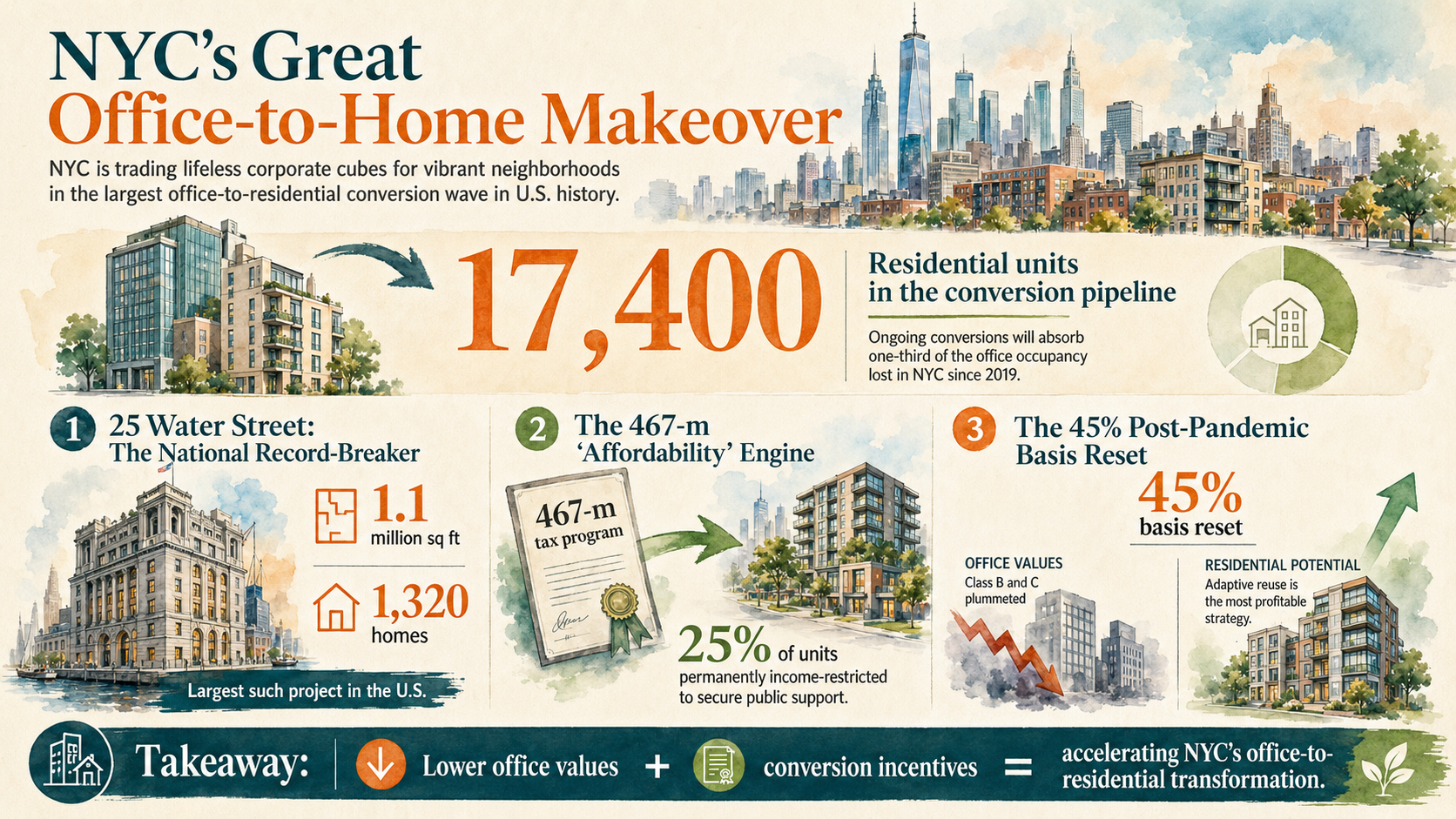
The current conversion pipeline is unusually large. It includes 15.2 million gross square feet across 44 projects, with the potential to create about 17,400 apartments. That would roughly triple the amount of housing produced from commercial space between 2012 and 2020.
But conversions are expensive and complicated. Most projects need regulatory and financial support to make the numbers work.
Figure 1 — The Strategic Role of EB-5 Capital in Large-Scale Urban Development
2. The Policy Engine Behind the Conversion Wave
Large office conversions usually require a major financial reset. The cost of buying, redesigning, financing, and rebuilding an office property into housing is often too high without public incentives.
That is why New York City and New York State introduced several major policy tools, including:
- The Affordable Housing from Commercial Conversions program, known as 467-m
- The 485-x program for new construction
- The City of Yes for Housing Opportunity zoning reforms
Together, these policies are designed to make conversions more feasible while requiring affordable housing in return.
467-m Phases for the MPDA
Property tax exemption schedule for Manhattan Prime Development Area
Phase 1
January 2023 – June 2026
90% property tax exemption. This represents the strongest benefit window — developers must commence before June 30, 2026 to qualify.
Phase 2
July 2026 – June 2028
65% property tax exemption.
Phase 3
July 2028 – June 2031
Phased from 50% down to 10%.
The Affordable Housing Requirement
25%
Units Reserved
≤80%
Weighted Avg AMI
∞
Rent Stabilized
To qualify for 467-m, developers must make 25% of the units income-restricted.
- At least 5% of all units must be restricted at 40% of Area Median Income, or AMI.
- The weighted average of restricted units cannot exceed 80% AMI.
- The income-restricted units must remain under rent stabilization permanently, even after the tax exemption expires.
This is a major part of the policy trade-off. Developers receive long-term tax relief, while the city gets permanently stabilized affordable housing in high-cost areas.
Zoning Reform and the FAR Cap
The zoning changes also expanded the number of buildings that can qualify for conversion.
Conversion eligibility now includes buildings constructed as recently as 1991. In addition, the removal of the 12 FAR cap for certain pre-1968 buildings unlocked high-density office towers that were previously very difficult or impossible to convert under residential zoning rules.
This change is especially important for buildings such as 5 Times Square, where the existing density is far above what older residential rules would have allowed.
3. Why Some Conversions Now Make Financial Sense
The key financial question is whether a building is worth more as renovated office space or converted residential space.
That comparison is often measured through residual land value. In simple terms, this is the value left after accounting for construction costs, financing, taxes, and the income the completed project is expected to generate.
For many older office buildings, the math has shifted. A residential conversion may now be worth more than an office renovation, especially if the project qualifies for 467-m.
This is the article’s central financial idea: the Conversion vs. Renovation Frontier.
Stylized Financial Analysis: 467-m Impact (Per Gross Square Foot)
Pro Forma| Metric | Without 467-m | With 467-m | Difference |
|---|---|---|---|
| Gross Income | $75 | $64 | -$11 |
| Property Tax | $21 | $2 | -$19 |
| Net Operating Income | $40 | $49 | +$9 |
| Residual Land Value, Yield on Cost | $122 | $250 | +$128 |
| Residual Land Value, NPV | $168 | $319 | +$151 |
Even though converted residential income may be lower than office income on a gross basis, the tax savings can make the net operating income stronger.
The Renovation Alternative
For buildings in corridors such as Third Avenue, owners may choose between office renovation and residential conversion.
One alternative is the Manhattan Commercial Revitalization program, or M-CORE, which supports office upgrades. But according to the original analysis, an owner would only be financially indifferent between renovation and conversion if the renovated office could reach 95% occupancy at $75 per square foot rents.
Given current market conditions, that may be difficult for many older office buildings. As a result, 467-m can make conversion the stronger option.
"An owner would be financially indifferent between office renovation and residential conversion only if a renovated office achieved 95% occupancy at $75/psf rents. Given current headwinds, 467-m tips the scales decisively toward conversion."
Figure 2 — Physical and Financial Anatomy of a Typical Office-to-Residential Conversion
4. Case Study: 25 Water Street
25 Water Street is one of the most important examples of the current conversion wave. The project is transforming a large 1960s office building into what the original article describes as the largest office-to-residential conversion in U.S. history.
The project involves a $787 million investment and converts 1.1 million gross square feet into 1,320 homes across a 76-story profile.
The project has been rebranded as SoMA and includes about 100000 square feet of amenities, including pickleball, spa space, and pools.
At the same time, the project includes 330 income-restricted units, equal to 25% of the total. According to the original article, studios through the housing lottery start at $932 per month for households at 40% to 90% AMI.
The larger takeaway is that 25 Water Street shows how Lower Manhattan is shifting. What was once a heavily corporate office district is increasingly becoming a mixed-use residential neighborhood.
SoMA by the Numbers
1.1M
Total Area
1,320
Delivered
$787M
Total Cost
76
Building Height
Studios
$932/mo
Starting at (40% AMI)
3-Bedrooms
$3,286/mo
Capped at (90% AMI)
5. One Wall Street: The Luxury Conversion Prototype
One Wall Street represents a different type of conversion.
Unlike many projects in the 467-m pipeline, One Wall Street is a luxury condominium conversion. It also predates the 467-m program, so its financial model is different. Instead of relying on long-term rental income and tax exemptions, the project is built around high-end residential sales.
The project reimagined the former Irving Trust Company headquarters, a landmark Art Deco building, into luxury condominiums.
Key points from the original article include:
- The project used $200 million in EB-5 capital as part of its financing.
- More than 50% of the 566 luxury units include dedicated home offices.
- The building is located about 40 feet from the New York Stock Exchange.
- A Whole Foods retail anchor helped support the residential ecosystem.
One Wall Street is important because it shows that the live-work trend was already influencing high-end residential design before the current wave of office distress and public incentives.
$200M
EB-5 Capital
566
Luxury Units
>50%
w/ Home Offices
6. Expanding the Conversion Market: 5 Times Square and 750 Third Avenue
The conversion story is no longer limited to older Class B or Class C office buildings. It now includes trophy-adjacent and Class A assets in major Midtown locations.
5 Times Square
5 Times Square, formerly the Ernst & Young headquarters, is a major example of how zoning reform expanded the conversion pipeline.
The project uses the lifted FAR cap and operates under a General Project Plan, or GPP. This allows the building to use a density of 33.4 FAR, which would not have been possible under the previous residential zoning framework.
The planned conversion is expected to deliver 1,250 homes in Midtown.
750 Third Avenue
750 Third Avenue shows how a conversion can potentially outperform the building’s prior office use.
The project is financially and structurally complex. The original article cites a conversion cost of $663 per gross square foot, driven by major façade removal and structural expansion to improve the residential floor plates.
The project targets net operating income of $47.5 million to $50 million. That is higher than the building’s 2019 office peak of $46.2 million, when it was 91% occupied.
A major part of the strategy is accessory use. The project is expected to include a gym and membership club that could generate $11 million to $13 million in annual rent. That extra income is a key reason the converted property could outperform the building’s previous office income.
5 Times Square
- Former Ernst & Young HQ — proving Class A conversion feasibility
- Expected to deliver 1,250 homes in Midtown
- Uses GPP to unlock 33.4 FAR density
750 Third Avenue
- Conversion cost of $663/GSF via façade removal & structural expansion
- Target NOI of $47.5M–$50M exceeds 2019 office peak of $46.2M
- Accessory gym & membership club generating $11M–$13M in annual rent
7. The Fiscal Trade-Off: The $5.1 Billion Question
The 467-m program comes with a significant public cost. The city gives up tax revenue in exchange for housing production and affordable units.
According to the original article, the NYC Comptroller’s analysis estimates the following for the Manhattan pipeline south of 59th Street:
The Fiscal Trade-Off: The $5.1 Billion Question
Comptroller| Metric | Lower Manhattan | Rest of Manhattan South of 59th | Total |
|---|---|---|---|
| Tax Expenditure, Present Value | $3.1 billion | $2.5 billion | $5.6 billion |
| Opportunity Cost, Present Value | $3.8 billion | $1.4 billion | $5.1 billion |
The distinction matters.
The $5.6 billion tax expenditure is the total value of the tax benefits. The $5.1 billion opportunity cost reflects the property tax revenue the city might have collected if the buildings became fully taxable, market-rate residential properties instead.
The article’s conclusion is that this cost must be understood in context. The program is not simply a giveaway. According to the original analysis, 81% of the opportunity cost is effectively absorbed by rent discounts for lower-income households.
In other words, the city is using the tax incentive to “purchase” affordable housing in locations where low-income residents would otherwise have very limited access. The article frames this as a way to use one of New York City’s scarcest resources — land — more efficiently.
The "Opportunity Cost" Nuance
81% of the program's opportunity cost is effectively absorbed by the rent discounts provided to lower-income families. The program essentially "purchases" affordable units in submarkets that are otherwise inaccessible to low-income residents, representing a more efficient use of the city's scarcest resource: land.
8. Strategic Takeaways
The office-to-residential conversion wave is reshaping New York City’s built environment. The article’s conclusion rests on four main points.
Scale and Vision
Large conversions require more than simply dividing office floors into apartments. Projects such as 25 Water Street show that successful conversions need a much bigger design and investment vision.
Amenities
In the current residential market, converted buildings must compete as lifestyle products. Clubs, spas, pools, high-quality retail, and other experience-driven amenities are increasingly important.
Incentives
The math of many complex conversions depends on 467-m. Without the tax incentive, many projects would likely fail to meet the required financial threshold.
Affordability
Permanent rent stabilization is the political and social cost of entry. In exchange for long-term tax relief, developers must provide lasting affordable housing.
Final Conclusion
New York City’s office-to-residential conversion wave is not just a design trend. It is a response to a structural shift in the office market, a housing shortage, and the city’s need to protect its tax base.
For investors and developers, the most important near-term date is June 30, 2026. That is the deadline to qualify for Phase 1 of the 467-m program, which provides the strongest benefit: a 90% tax exemption.
The next several quarters will likely determine which office buildings successfully cross the conversion frontier and which remain stuck as obsolete commercial assets.
Frequently Asked Questions
What is office-to-residential conversion in NYC?
Office-to-residential conversion in NYC is the process of transforming obsolete or underperforming commercial office buildings into residential housing. The current pipeline includes approximately 15.2 million gross square feet across 44 projects, with the potential to create about 17,400 apartments.
What is the 467-m tax incentive?
467-m is New York's Affordable Housing from Commercial Conversions tax incentive. It provides partial property tax exemptions of up to 90% for eligible non-residential-to-residential conversions that include at least 25% affordable housing units, with the affordable units permanently rent-stabilized.
Why are older Manhattan office buildings being converted to housing?
Remote work has accelerated a structural shift that made many older Class A, B, and C office buildings difficult to lease. At the same time, NYC faces a severe housing shortage. These twin pressures — rising office vacancy and housing demand — make residential conversion both economically rational and policy-supported.
How many apartments could NYC office conversions create?
The current NYC office-to-residential conversion pipeline could create approximately 17,400 new apartments across 44 active projects encompassing 15.2 million gross square feet, roughly tripling the housing produced from commercial space between 2012 and 2020.
Why is 25 Water Street important?
25 Water Street (rebranded as SoMA) is the largest office-to-residential conversion in U.S. history. It transforms 1.1 million gross square feet of 1960s office space into 1,320 homes, including 330 income-restricted units, with a total investment of $787 million.
What changed with the FAR cap?
The City of Yes zoning reforms removed the 12 FAR (Floor Area Ratio) cap for certain pre-1968 buildings, unlocking high-density office towers for residential conversion that were previously impossible under older residential zoning rules. This enabled projects like 5 Times Square at 33.4 FAR.
Are office conversions financially feasible without tax incentives?
Most large-scale office conversions are not financially feasible without 467-m tax incentives. Without the exemption, residual land values are too low to justify the high construction costs. The 467-m program can more than double residual land value, making conversion the stronger option versus office renovation.
Which NYC office buildings are major conversion examples?
Major NYC office-to-residential conversion examples include 25 Water Street (SoMA, 1,320 homes), One Wall Street (566 luxury condos), 5 Times Square (1,250 planned homes), and 750 Third Avenue (targeting $47.5M–$50M NOI, exceeding its 2019 office peak).
Want to discuss this further?
The market moves fast, but you don't have to navigate it alone. Connect with our advisory team to explore how these insights impact your specific real estate strategy.
Contact Our Agents